
A Poem I Love
“Pied Beauty” by Gerard Manly Hopkins

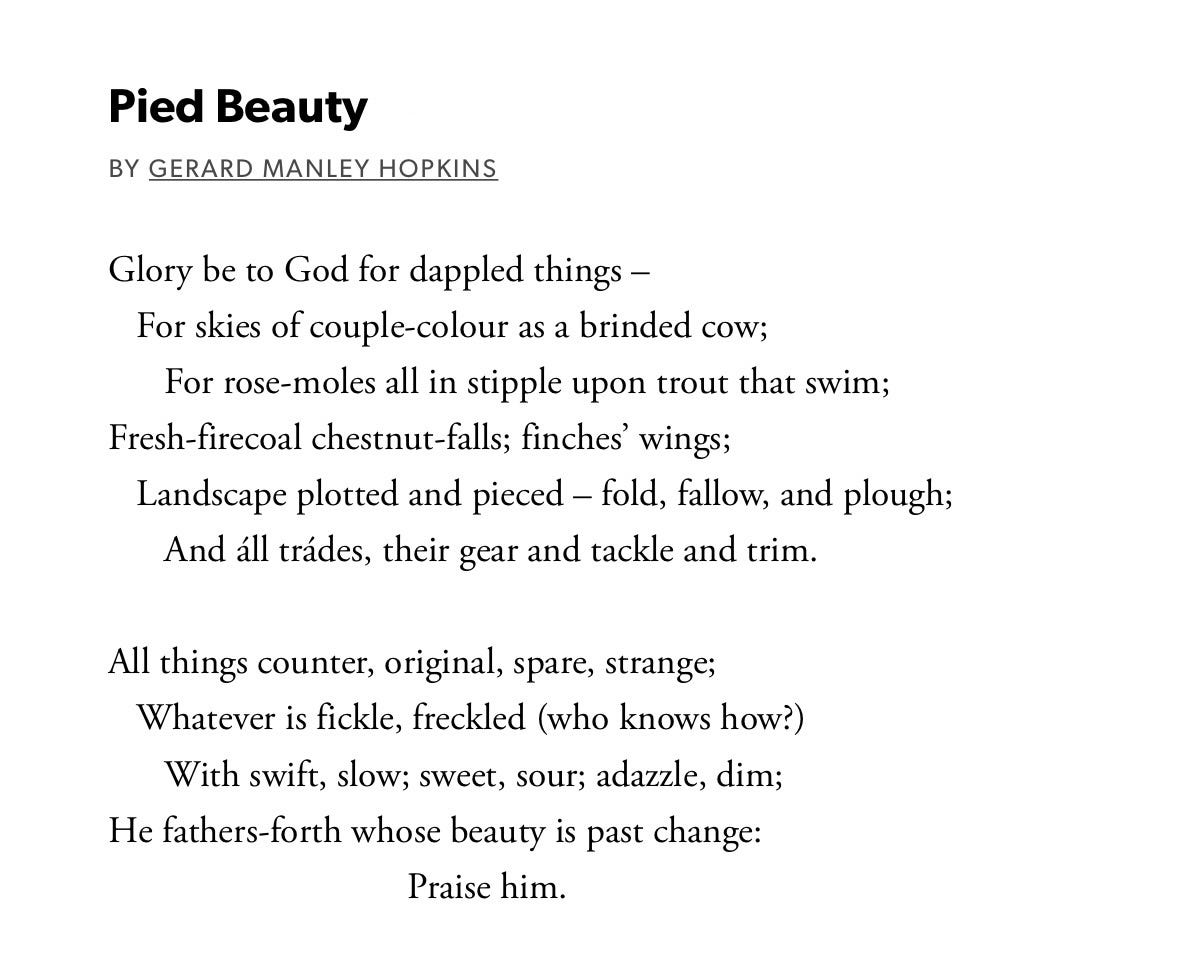
I know I say this about every poem I post, but this poem truly MUST be read out loud. Unlike many poets of his time, who wrote in conventional meter (like iambic pentameter or other similar rhythms), Gerard Manley Hopkins was drawn to a rhythmic structure that harkens back to the Anglo-Saxons—found most notably in the Old English epic, Beowulf. He referred to it as “sprung” rhythm and favored it because he felt it allowed for more variety in his writing1 You don’t really need to know anything about rhythm to know that Hopkins is doing something totally satisfying (here in “Pied Beauty” as in may of his other poems). You just need to read out loud and feel it.
The poem opens with a proclamation—“Glory be to God for dappled things” tagging it as a poem of praise, but the object of that praise is somewhat unexpected. Hopkins seeks to honor dappled things, which feels contrary in a subtle way. To be dappled is perhaps to be imperfect. Freckled instead of ivory pristine. In the lines that follow, Hopkins cites the “skies of couple-colour,” the “brinded cow,” the “finches’ wings.” The third line is my favorite, with “rose-moles” calling to mind the image of a speckled rose (another wonderful dappled thing) before he surprises you by placing the rose-mole on the sides of “the trout that swim.” His use of the word stipple, “all in stipple,” is soo delicious. The alliteration of “fresh-firecoal chestnut-falls” similarly displays Hopkins’s focus on the sound of things.
In the last two lines of the first stanza, he broadens his lens, expands to whole landscapes, that are “plotted and pieced,” plowed, dotted, furrowed. We’ve zoomed out to a bird's eye—God’s-eye—view, all the better for the one we are praising to view his creation, here the sheep, here the fields ready for planting. It calls man to mind, and Hopkins says yes, all trades too (accents included for metrical reasons) are from God and honor Him in their variety.
In the second stanza, the humble nature of this praise—hinted at in line one—is made explicit. They are not just dappled, but “counter, original, spare, strange…fickle, freckled,” and still worthy of praise! Beyond our understanding, part of some larger map or constellation, and therefore worthy of our praise. Even, or perhaps especially to those things that appear to be in contradiction (swift and slow, sweet and sour, adazzle and dim), we must pour forth our praise. God “whose beauty is past change,” who is perpetually perfect, “fathers-forth” these mysterious pleasures and gifts. And in the end, it is not an exclamation or entreaty, but a command: “Praise him.”


This poem came into my mind because it was referenced by Linda Gregg in an essay I was assigned in my poetry workshop last month. She says that Hopkins, and poems like “Pied Beauty” in particular, “gave [her] a special way of knowing the earth and experiencing God,” and I couldn’t put it better myself. Xx
For those interested, Hopkins’s “sprung” rhythm relies on metrical feet with one to four syllables, with the first syllable stressed, whereas more conventional rhythms like iambic pentameter rely on the iamb, a two syllable foot in which the first syllable is unstressed, the second syllable stressed.