A Poem I Love
“Putting in the Seed” by Robert Frost

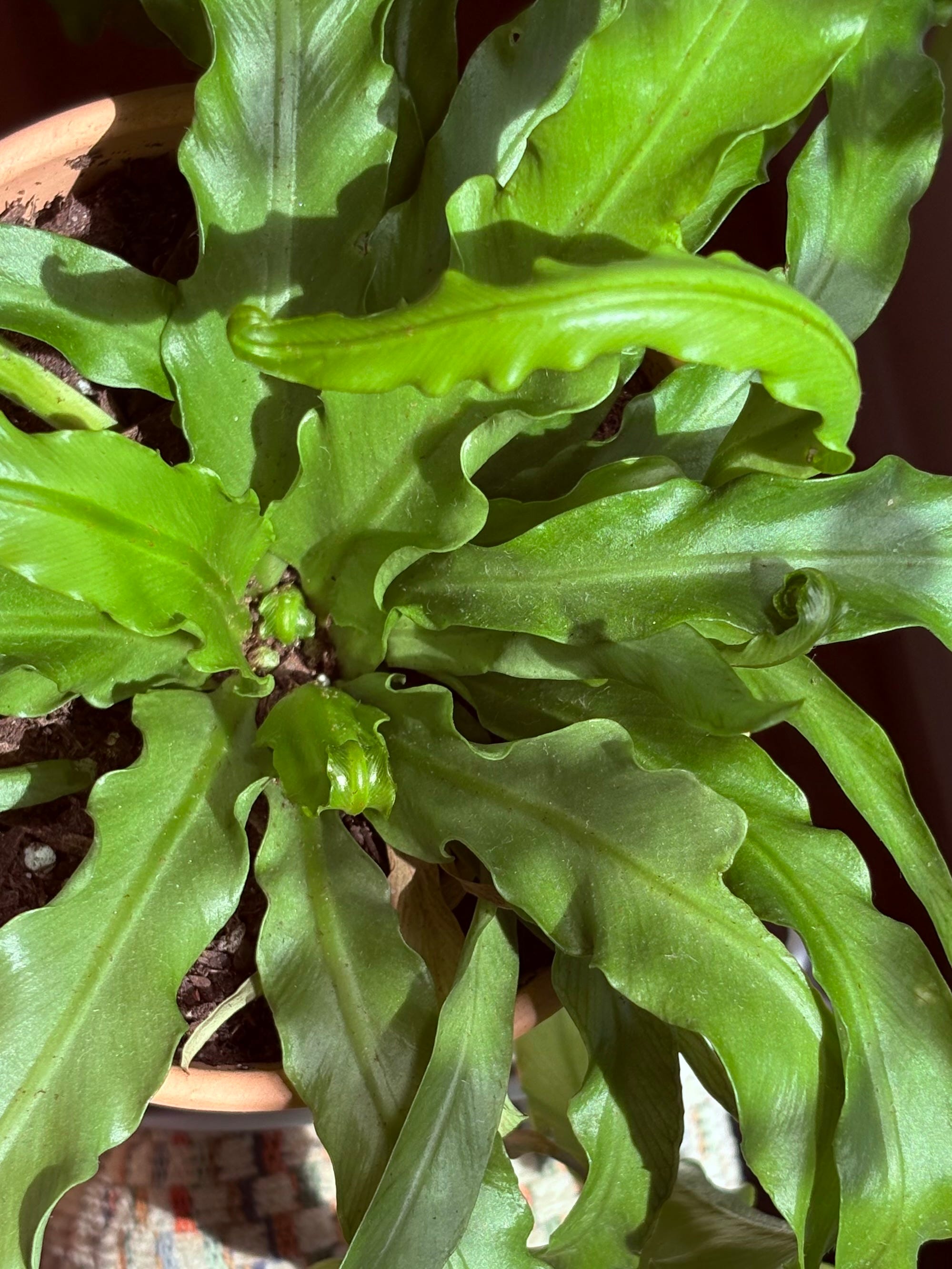
I think I’ve written about this poem before, but it popped into my mind the other day. I recently bought a fern for my shower—it’s apparently a crispy wave fern, which feels like an undignified name to me—and new leaves unfurl from its center, which I’ve been made to understand should not be watered directly under any circumstances. Peering into this fragile center, I saw a glistening new growth, curled tight like a spring, waiting I guess to spring, and I thought to myself, it’s shouldering through, which put me in mind of Frost’s “Putting in the Seed.”
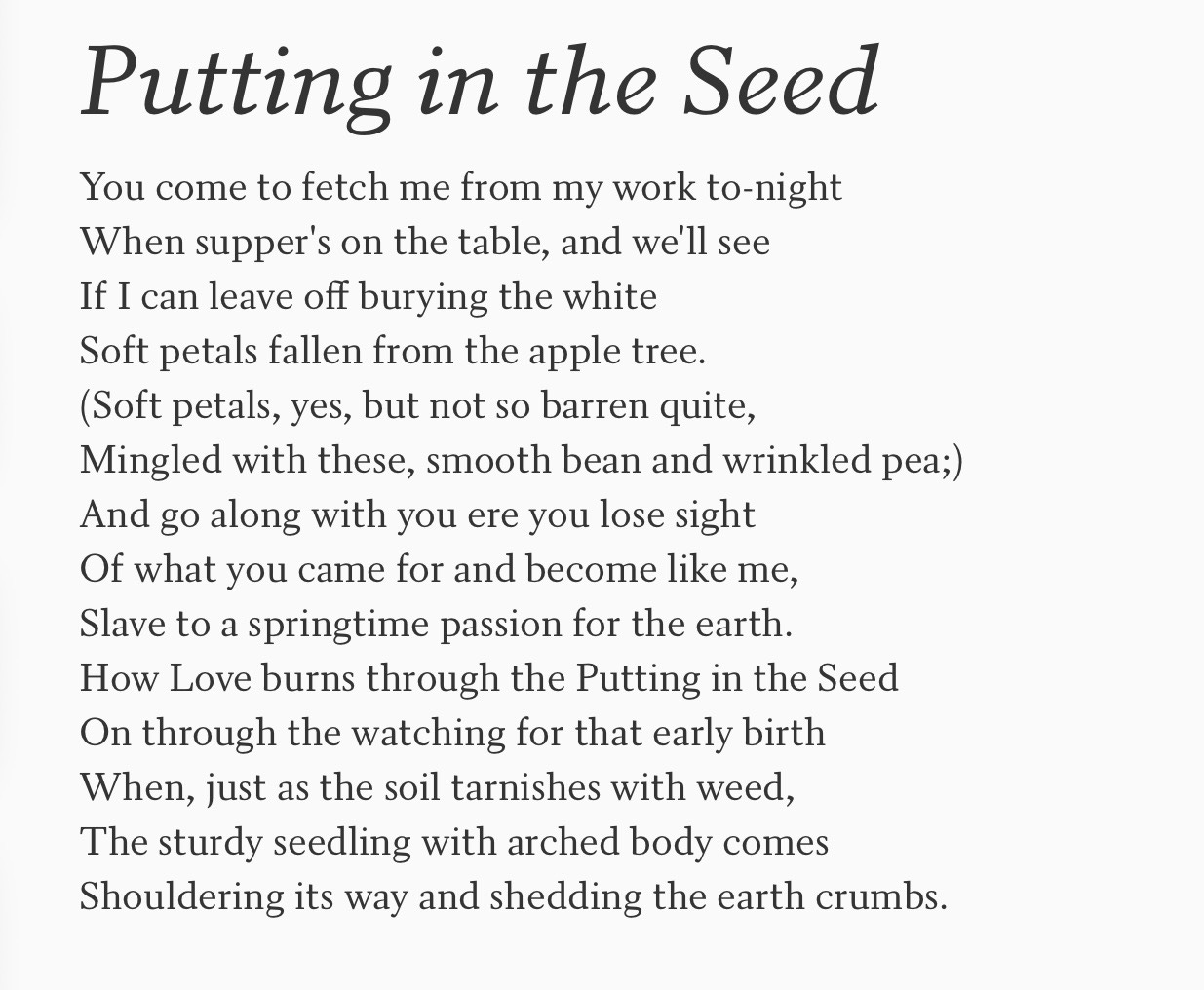
To touch on form first, “Putting in the Seed” is a sonnet—close to a Petrarchan sonnet, though with a modified rhyme, and the Volta, or the turn, happens in the ninth line instead of the eighth. It’s written in iambic pentameter, which gives it such a pleasing sound. Of course—like all poetry, it must be read OUT LOUD.
Before I start sounding like your high school English teacher, though, let the form and meter fade into the background (important and impressive though they are). Frost begins by setting a simple scene. The speaker is out in the garden, and someone a “you,” most likely a wife, comes to call him to supper. He’s so engrossed in his work that he’s not sure he’ll be able to “leave off.” He’s burying “soft petals fallen” along with beans and peas. This is a late spring, maybe even early summer scene, and though the first signs of life, the early apple blossoms, are fallen to decay, the beans and peas are being planted for summer growth.
This dichotomy, death and the act of burying, along with birth and the formation of life, is central to the poem, and highlighted most starkly in his parenthetical interjection—“not so barren quite!!” Quickly, his dedication to the planting task turns into something compulsive and possibly contagious. If he lingers and his wife stays outside waiting for him for too long, she might forget herself and like him, become a “slave to springtime passion for the earth.” It’s here that the poem first takes a sensual turn, but the true turn is accomplished in the next line: “How Love burns through Putting in the Seed,” the productive, reproductive act.
Importantly, however, this burning love carries through to the “watching for that early birth,“ that hoping and that waiting for the arrival of new life. And just when it seems that the weeds are coming up to strangle the young seedling, even when conditions aren’t ideal, the “arched body” of young life comes “shouldering it’s way and shedding the earth crumbs.” I love how much life and vitality is coiled up in that arched body—how much effort in the shouldering. Life is determined to live.
It’s just a delicious poem, and I hope it inspires at least one of you to plant a garden or otherwise to reproduce with haste. LOVE BURNS THROUGH PUTTING IN THE SEED. Xx