
Last Month’s Read
April 2026

Last Month I read Lies and Sorcery by Elsa Morante. As predicted, it took me the whole month to get through it, but not solely because it scratches 800 pages. In fact, fairly early in the month I’d made it to the halfway point. Sally, I was unable to continue apace. The back half was…a slog.
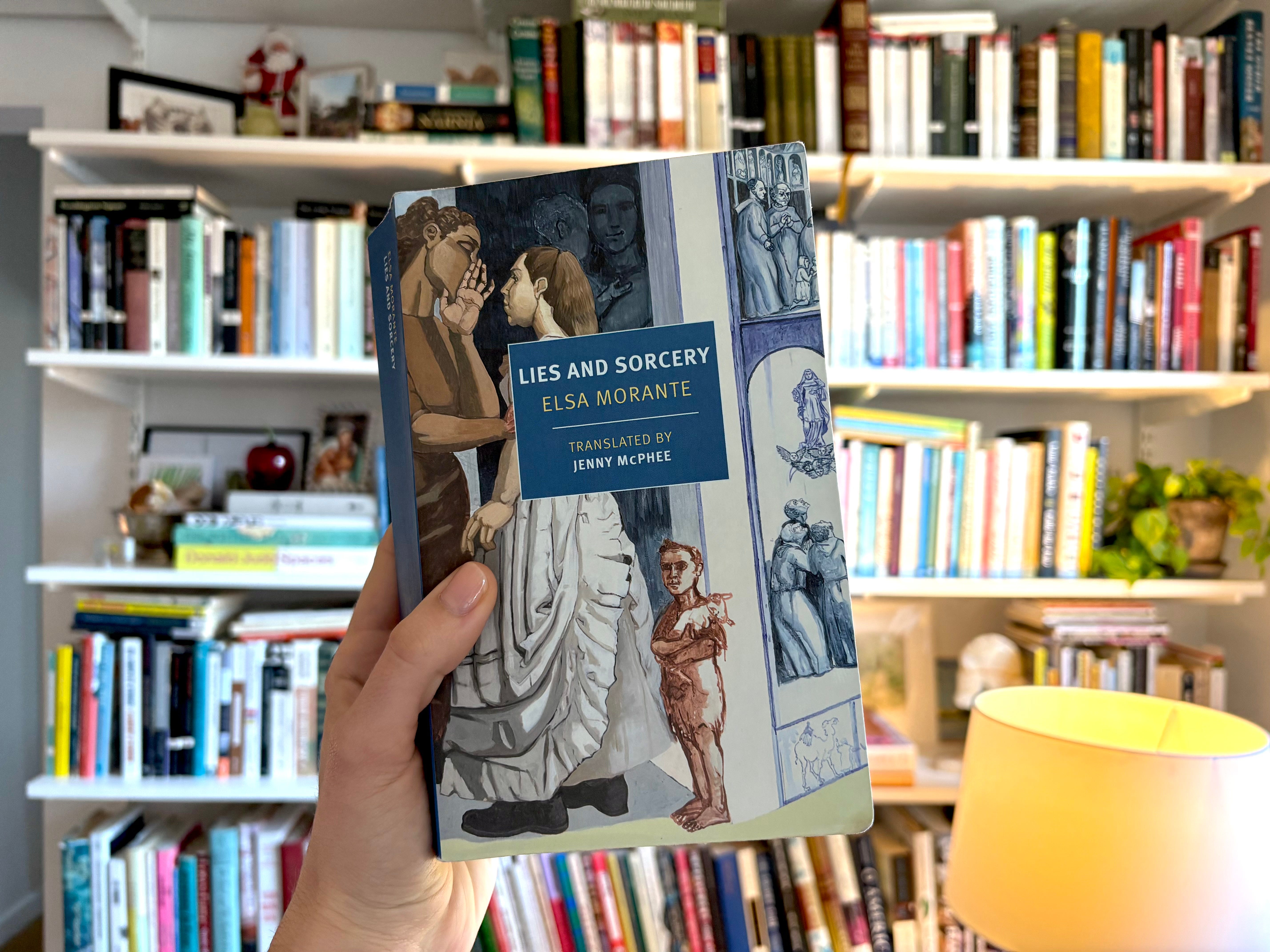
Lies and Sorcery was published in 1948 to much praise. Natalia Ginzburg later recalled reading an early manuscript and being “filled with vitality and joy.” This, reader, can be described as nothing but a totally insane reaction to the text. Morante’s husband, Alberto Moravia, called the novel genius. Slightly less insane. Italo Calvino called it a “serious novel” that “successfully penetrates to the bone,” which I would say is more in line with my experience of it.
The novel is set around the turn of the 20th century in southern Italy, and tells the story of one family over three generations, as narrated by Elisa, the youngest member of the clan and sole survivor. We learn in the introduction that Elisa’s parents—Anna and Francesco—have been dead for several years. Upon their death, she was adopted by a fallen woman, Rosaria, who she has lived with in relative isolation for the past several years. At the opening of the book, Rosaria has died, leaving Elisa completely alone in the world.
Alone, that is, save for the ghosts of her ancestors. During the years she lived with Rosaria, Elisa often shut herself up in her room fantasizing about her ancestors and their grand romantic lives. In her mind they were princes, saints, dukes and queens. She spun stories to entertain herself in her solitude—spurning Rosaria’s unsavory lifestyle—and she began to believe her own stories. When she finds herself truly alone, these fantastical ghosts abandon her too and are replaced with memory.
Elisa finds that she can suddenly remember, with great precision, her entire past, and not just that—she can remember the pasts of her dead ancestors as well, the true version of events. She says, “Things I never knew about I now understood and I could retrace their lives from the beginning, as if their experiences were mine.” These memories come to her in light early morning dreams, whispered in the voices of her ancestors. She rises and each morning “like a faithful secretary” writes it all down. And this is how the story begins.
We meet Cesira, Elisa’s maternal grandmother, who grew up in a middle class family but had too high a sense of herself and too great of ambitions to continue in that station. She catches herself a nobleman, Teodoro, though much to her chagrin his family disowns and disinherits him in response to their marriage. Teodoro, Cesira and soon enough their daughter, Anna, are plunged into debt. In Anna’s early life, Cesira’s overwhelming disappointment and resultant hardness contrast with Teodoro’s good nature and charm. Though the family lives in near poverty, Teodoro regales Anna with embellished stories of his noble upbringing (not unlike the stories Elisa spins for herself two generations later) and instills in her that unwarranted and poisonous sense of her own superiority. Like her mother and father, Anna will contend with the feeling that she deserves better—that she is better—than what she has for the rest of her life.
This is in some ways the center of the novel: the terrible restriction of the traditional (archaic?) social and class structures that were still so prominent in Italy during this time. Morante puts the effects of such repression on full display in her characters, each one more miserable and unlikeable than the last. The poor are bitter, the rich careless. No one wins, but no alternative is presented. Even poor little Elisa, who comes into the world when Anna, after a life altering brush with her noble cousin Edoardo, is driven to marry Francesco by bitter necessity, is hardly a compelling character. I pitied her, but that was about the extent of it.
As I soldiered through, I found myself wondering what the point was. There were moments where I expected Morante to stake a claim or take a perspective. For a section of the novel, young Francesco is captivated by Marx and dreams of creating a more equal world, but his drive doubles back on itself and goes nowhere. Beyond painting a striking portrait of one troubled family against very particular social and economic backdrop, Morante doesn’t offer a path out of the trouble, until you realize that she actually already did, on page 24 at that. At the end of Elisa’s introduction she confides in her reader: “Perhaps by reconstructing my family’s story, I will finally be able to solve the mystery of my childhood as well as discover the truth behind all the other family myths…This is why I obey their voices and write. Who knows, perhaps with their help I may at last be able to leave this room.”
It’s worth noting that Elena Ferrante (whoever she is) cites Morante as one of her major influences. For Ferrante lovers, Lies and Sorcery may be a compelling text if only to place Ferrante’s work within the larger context of the Italian novel. It’s been a while, but I remember loving the Neapolitan Quartet. Ferrante is certainly unflinching when it comes to the flaws of her characters, but I remember rooting for them nonetheless, liking them flaws and all. Consider this your warning: not so with Lies and Sorcery.
Ahhhh, the big book fear is so real! Good on you for commuting to this monster.