
Last Month's Reads
July 2026

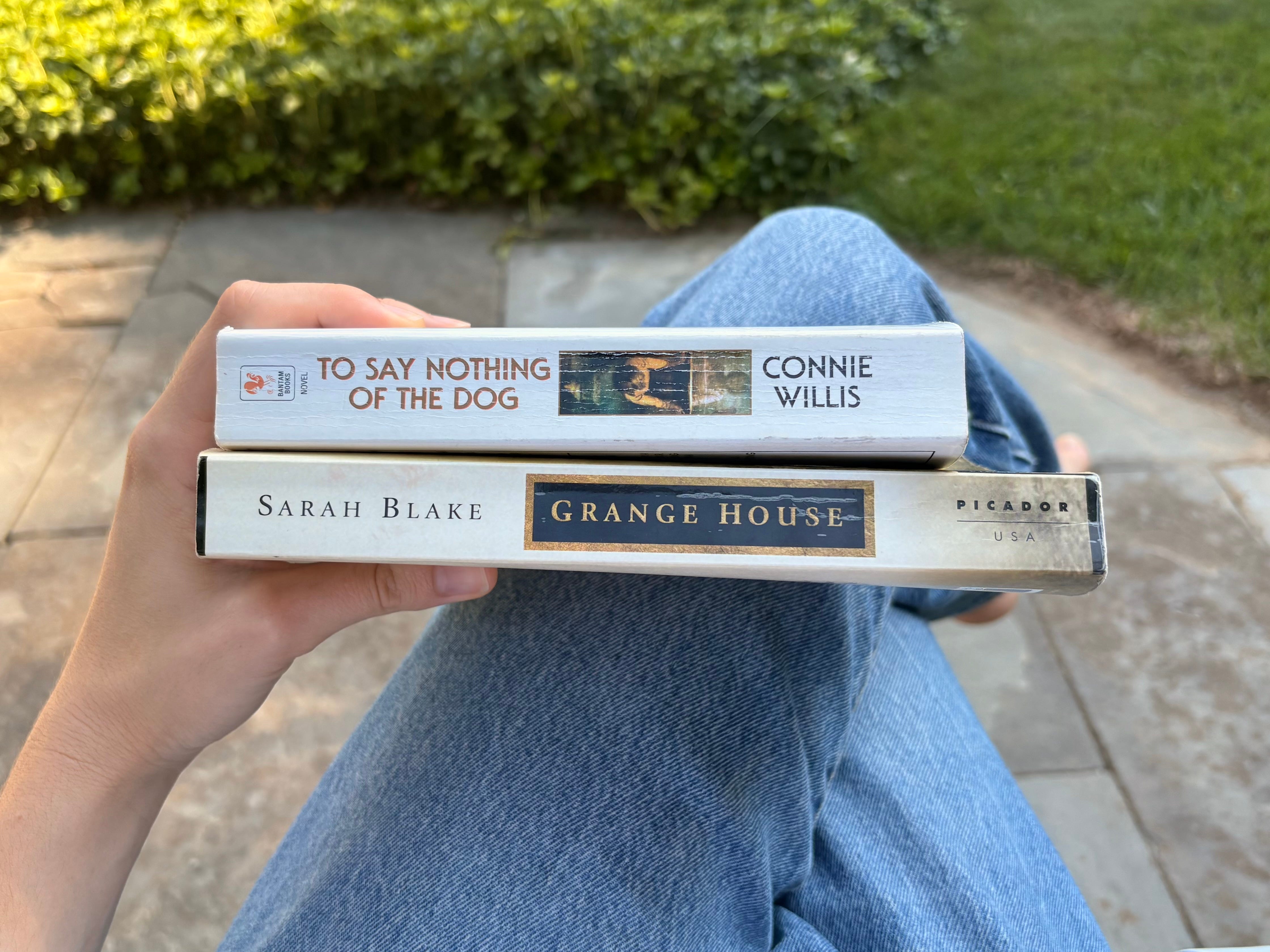
After finishing Flush last month, I took a little break (4 days) before jumping into my next read, which is somewhat unusual for me. The first Sunday of the month rolled around, and I had to pick something, since when my lover and I go to Sunday dinner, I always arrive 20-75 minutes early to read my book at the bar or on a folding chair outside.
I pulled Grange House by Sarah Blake off the shelf, thinking maybe it would be a little romantic. I don’t remember when or where I found this one, but it’s so random, it must have come from Housing Works. The back blurb begins “In 1896, when Maisie Thomas turns seventeen, her annual summer visit to a hotel on the coast of Maine…” and I stopped reading there because that was good enough for me. Off to dinner I went!
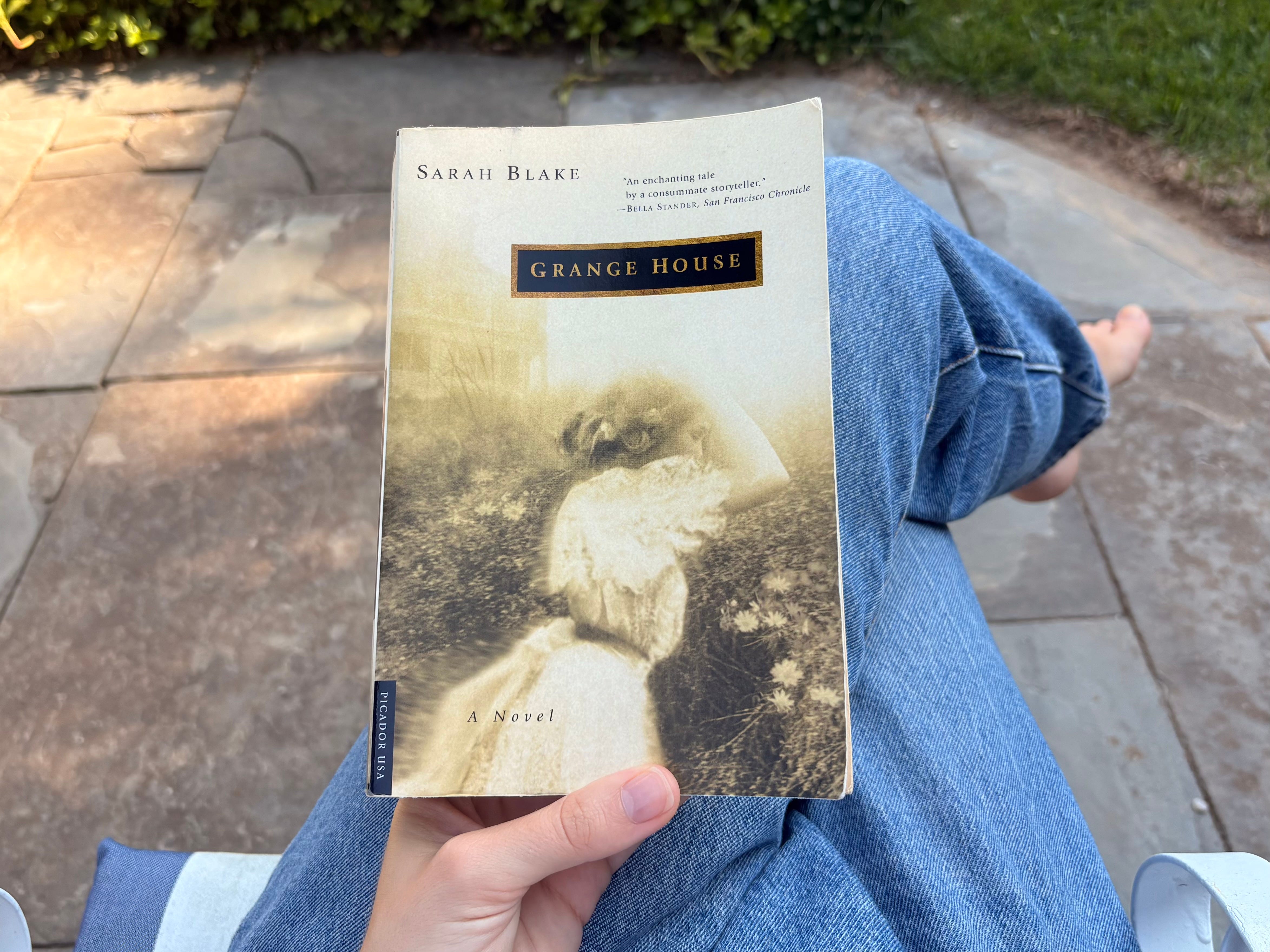
The novel is narrated by Maisie, age 17 in 1896. Years before her birth, her father invested in the Grange Quarry, and over the course of his visits to the site, developed an affection for coastal Maine. The Grange family, the once prosperous proprietors of that quarry were forced to convert their mansion into a hotel once the business shut down, at which point Mr. Thomas determined to return every summer, eventually with wife and baby Maisie in tow.
Maisie is very much on the precipice of, well, everything, and her heightened emotional state blends well with the mystery that has always seemed to surround Grange House—and its sole surviving Grange inhabitant, the authoress Nell Grange, up in her attic apartment. Maisie is “as eager to know the world as it seems eager to shroud itself” from her. She feels, in a very teenage way, that her return to Grange House can be the reanimating force to set everything—surely frozen in place while she was gone—back into motion: “Let the story begin, I thought impatiently, now that I am here—though what I meant by that, I had not the slightest idea.”
On the second day, tragedy strikes when the boat builder’s son and the cook’s daughter are discovered drowned in each other’s embrace. This event sets off the more gothic strain of the novel, which, I regret to report, tended towards the convoluted. Nell has secrets and has singled Maisie out as the recipient of the stories she hasn’t yet written. She keeps saying that the story has to be written so that it doesn’t repeat itself. I wasn’t totally convinced of her commitment to preventing this potential repetition, though, since her manner of relating the events of the past is obfuscatory to the extreme. Nell’s story is eventually mostly revealed through journal entries which are spliced into the narrative in two large chunks. I thought this was fine, but wished that the journal entries were more evenly distributed throughout Maisie’s story, since Nell manages to make sense in her writing in a way that is beyond her when it comes to verbal expression.
Blake is clearly interested in exploring womanhood in Victorian era New England. Maisie is being pushed, inch by inch, towards marriage. She rankles against expectations, early on shocking two other young women at Grange House who aren’t interested in ~deeper~ things like she is by announcing that there’s “altogether too much fuss made about marriage.” She looks to Nell as an alternative example, and Nell is happy to stand in that role. At one point when the pair are walking in the woods and Maisie remarks that a tree growing out of a boulder has “adapted to its situation,” and in something of a non sequitur, Nell starts quoting from an etiquette book and pronouncing that “Adaptation…is well for a tree, Maisie—never for a woman.” Okay, lol. Unfortunately, what the story lacks in subtlety, it does not make up for in consistency. By the end of the novel, once Maisie and Nell’s stories are revealed in full, one doesn’t walk away feeling inspired by the fortitude of womankind. Nell dies (sorry) without even knowing the truth about her own live, Maisie can’t handle the truth, and the other women in the novel—Nell’s mother and sister and Maisie’s mother, get the short end of the stick in a major way.
It wasn’t all bad. Like I said, Blake accurately captures a certain teenage-ness that I always find compelling. I also thought that Maisie’s decision between her two potential suitors was interestingly constructed over the course of the novel. I would have liked more romance and less ghosts, but that’s just me! As for the writing, it’s worth noting that Blake adopts a Victorian style and commits. It’s anachronistic in some places and overly flowery in others, but to her credit, mostly successfully executed. That’s all I have to say on that!
Next, since I was already in random book land, I scanned my shelf for another book I knew nothing about by another author I knew nothing about. One spine stood out among the rest: To Say Nothing of the Dog by Connie Willis. I picked this up off the staff recommendations table at McNally Jackson a couple years ago and couldn’t get past the first page when I tried to read it back then. Really, the whole first chapter is confusing, so one must be prepared to power through. Funnily enough and totally unplanned, this is another modern take on the Victorian era. We love an unintentional ~reading theme~.
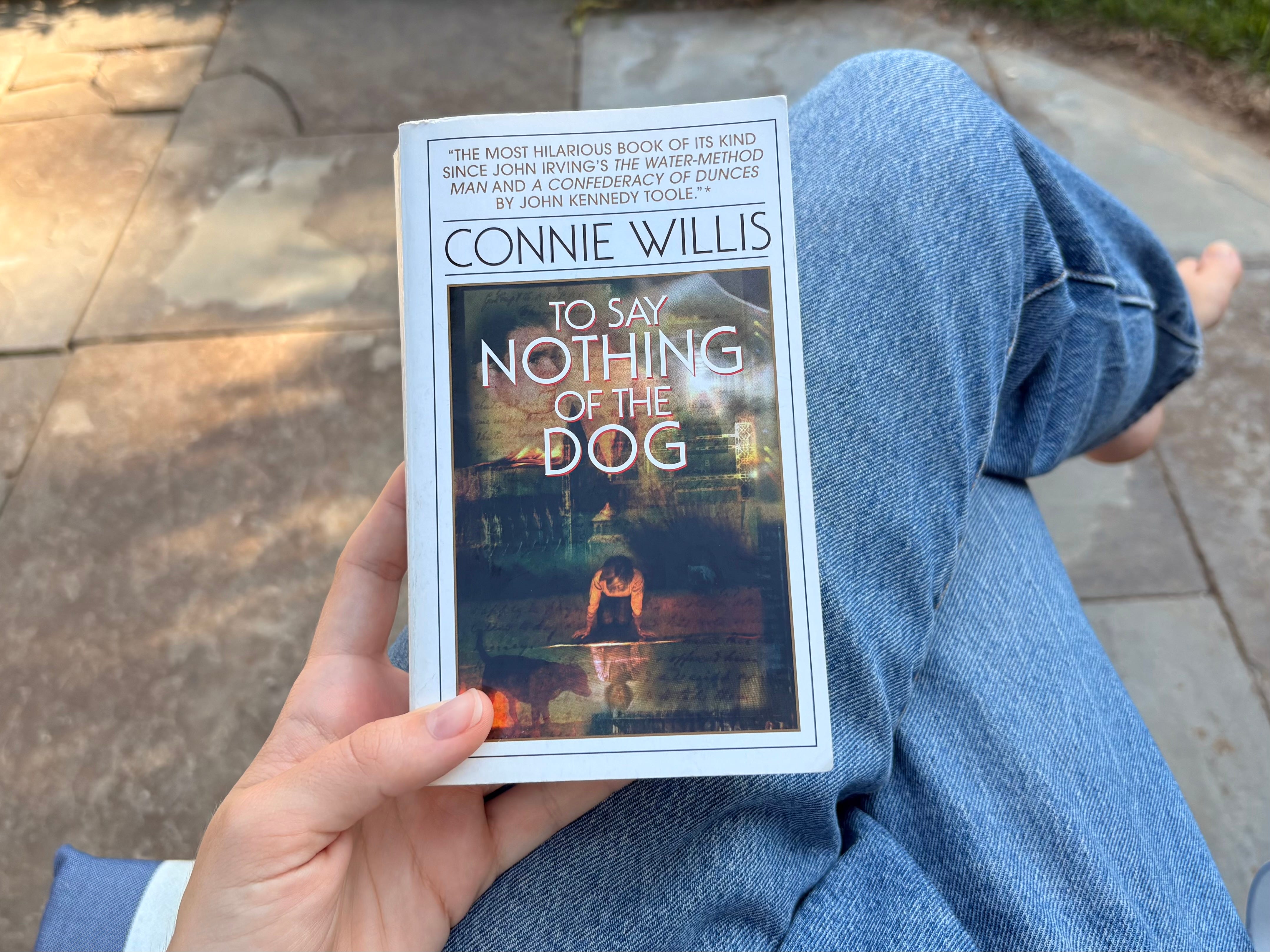
I should caveat, as I act like Connie Willis is some random unknown, that I am now aware that she’s an award winning sci-fi author. I could be forgiven for not realizing when one knows that To Say Nothing of the Dog is described on the front cover as “the most hilarious book of its kind” (according to the Des Moines Sunday Register, so like take that with a grain of salt), and on the back cover as a “romp through an unpredictable world of mystery, love, and time travel” that will “carry you off to a place where chaos theory makes perfect sense.” I didn’t know what to expect! Now having read the thing, I won’t argue with any of these claims, other than the one about chaos theory making perfect sense.
The year is 2057 (comically soon), and Ned Henry is a time travel researcher with Oxford’s history department. Or at least he was until the menacing Lady Schrapnell, with her wads and wads of cash, started demanding that the department work for her. After reading her great-great-great-grandmother’s diary, which mentions a life changing trip to Coventry Cathedral in 1888, she decided to commit her life (and those wads of cash) to reconstructing the cathedral, which was destroyed in the Blitz. Okay! This apparently requires a lot of time travelers running around in the years between 1888 and 1940, ‘researching’ what the cathedral looked like, what was inside it, what fabric the choir boys gowns were made of, etc.
Ned’s done too many ‘drops’ for Lady Schrapnell and has started experiencing the symptoms of time-lag (auditory hallucinations and a tendency to maudlin sentimentality among others), so he gets pulled out of 1940. When he lands in the lab back at Oxford, he learns that there’s been an issue with a cat that was maybe supposed to drown back in 1888 but didn’t because another time traveler intervened, so now there MIGHT be an incongruity brewing that MIGHT destroy the space time continuum, etc. Either way, he needs to go somewhere quiet where he can hide from Lady Schrapnell and recover from his time-lag, so it’s off to 1888 Oxford for him. Maybe he will be able to help with the cat issue while he’s there.
There’s no cat when he arrives, and while he knows that he’s meant to find that other time traveler (the cat saver), he’s not sure how or where to do so. The first person who intercepts him is one Terence St. Trewes—not in fact a time traveler, but an Oxford student who wants to travel down river to help some lady named Tossie find her cat, which seems promising. Terence is more than willing to bring Ned along once he learns that his new friend has money to cover the boat rental.1 They eventually connect with Verity who is the other time traveler, posing as Tossie’s distant relation in order to get her hands on her diary. Yes, little old Tossie is Lady Schrapnell’s great-great-great-grandmother. It’s off to the races from there!
This ended up being less serious and more genre driven than I was expecting, though the mass-market paperback format could have been a giveaway. There were moments in the middle when the pacing felt a tad slow, and Willis didn’t completely avoid my genre-fiction pet peeve of repeating information that’s already been covered to make sure the reader is still keeping up (I am!). Additionally the inclusion of some of the more in depth mechanics of time travel did not serve me. However! I won’t even dock points for any of that.
This book was so much fun, I couldn’t put it down. It was hilarious! It was a romp! Mystery, romance, time travel, check check check! To this catalogue of praise, I would add: charming in that particular British way that just really cannot be imitated. One of my own dear readers shared last week that Doomsday Book—another of Willis’s books—is even better, so it’s taken its spot on my list of books to buy eventually.
Ta ta for now!
Worth noting, the boat trip on the Themes is Willis’s homage to the fictionalized comic travelogue, Three Men in a Boat, To Say Nothing of the Dog by Jerome K. Jerome. I haven’t read it but would like to.