
Last Month's Reads
June 2026

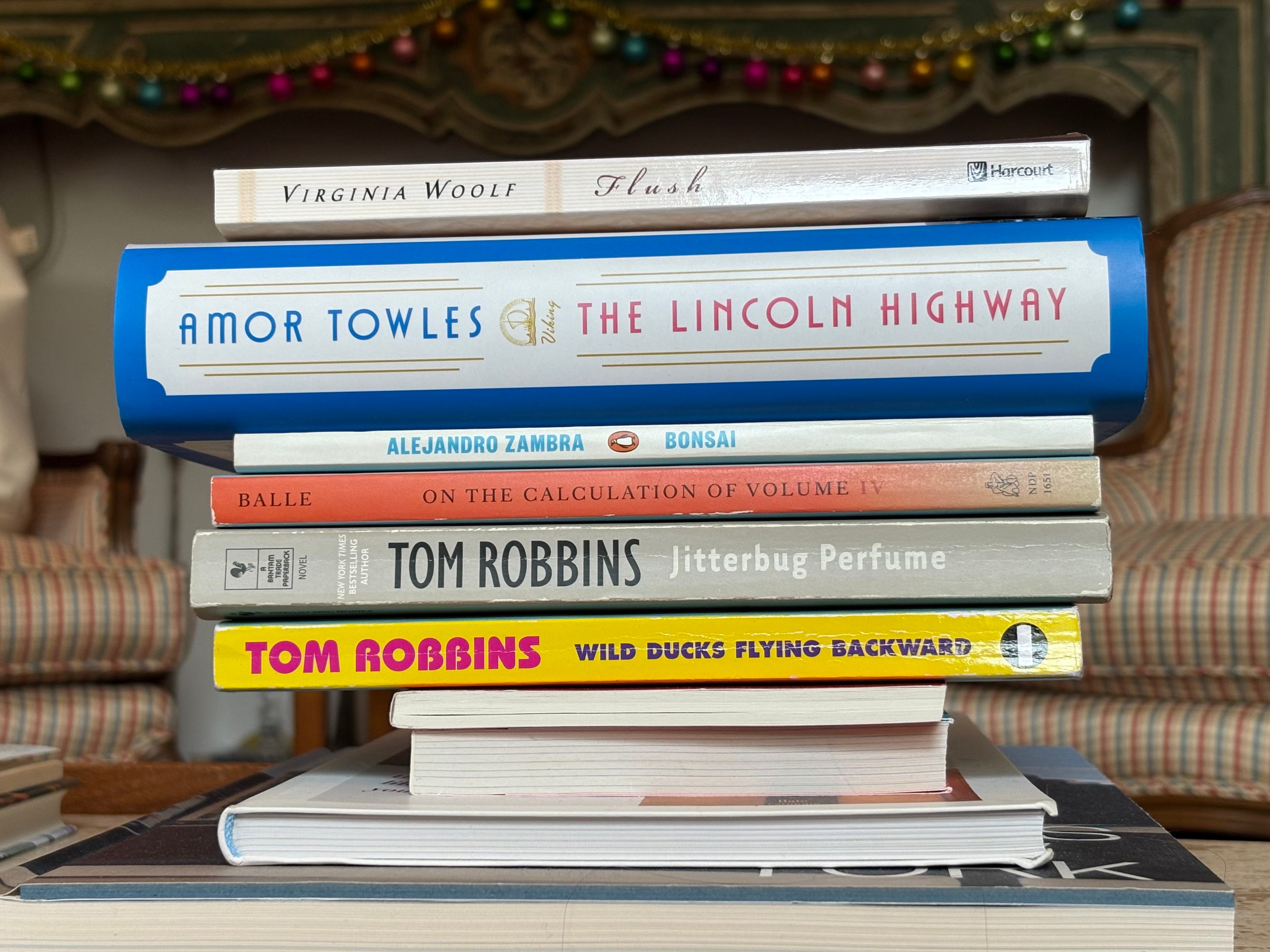
At the end of May I finished up Outline and was lost. These days, I stare at my bookshelf, and the same books that I haven’t reallllly felt like reading for the past ~3 years stare back. Of course at some point (when I bought them), I wanted to read these books. But now…well. And I know it’s largely a trick of the mind—just knowing they’ve been sitting on the shelf forever makes them less appealing to me. But still, it produces a certain sense of dread. This is heightened at the beginning of the month, when I feel like my choice risks setting the wrong tone for an entire month. (This is obviously not a Thing, but still).
So, feeling kind of non-committal and like I wanted something that would feel more…male after Cusk, I started reading Wild Ducks Flying Backward by Tom Robbins. I picked this one up at the Strand with the vague sense that I wanted to read more Robbins. I read Only Cowgirls Get the Blues a few years ago, and found it highly compelling. For a window into the full extend of my book buying PROBLEM I will share that when I bought Wild Ducks with the vague sense that I wanted to read more Robbins, I was already the proud owner of another novel by the man himself! But more on that momentarily.
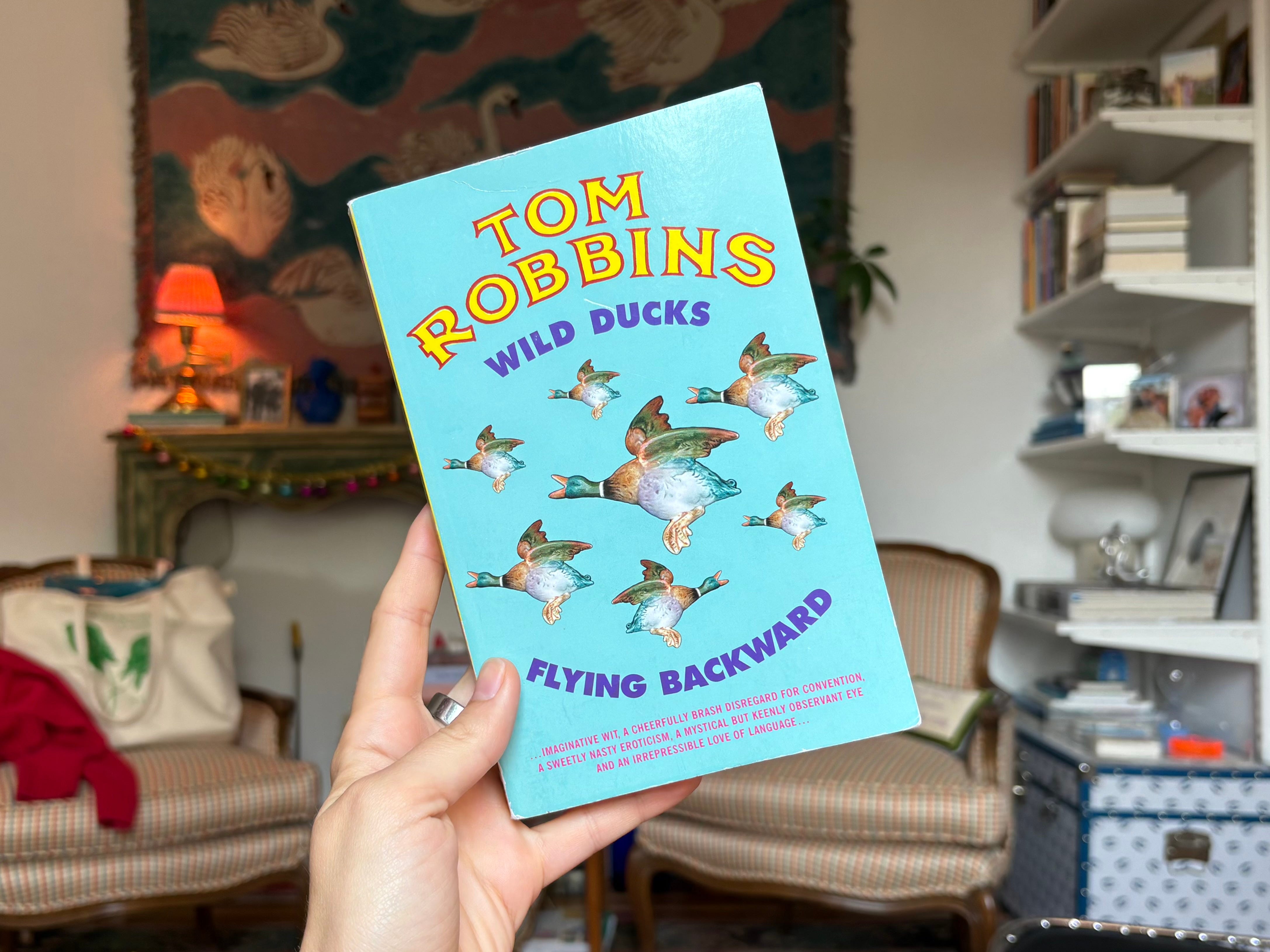
Wild Ducks Flying Backward is a collection of Robbins’s shorter writings. In his characteristically tongue in cheek introduction, he imagines the reader settling down on an evening when it may rain or may snow, with a little dram of something strong to get the mental juices flowing. The reader has procured a copy of Tom Robbins’s latest, but finds herself “somewhat disgruntled” to discover that it’s not a novel at all. By the end of the introduction I didn’t care what it was. I was totally delighted with myself for my offhand choice. I had forgotten how amusing and engaging Robbins’s writing is. There’s just no one else like him. I rolled my eyes a couple times—like I might at a mildly inappropriate uncle—but I laughed out loud far more often (coincidentally, also like I would at a mildly inappropriate uncle).
This collection includes travel writings, in which we get to accompany our fearless leader through the African bush, into the Canyon of Vaginas, and to dinner with a tribe of rumored (former?) cannibals. From there, he moves on to tributes—quick hits in which he pays homage to some of his favorite things. There’s The Doors and Jennifer Jason Leigh, Redheads and Miniskirt Feminism, and my personal favorite Slipper Sipping (whereby a man sips champagne (it must be champagne) from a woman’s shoe—“no gesture in the annals of romantic behavior is quite as auspicious”).
Next, we get stories (one enticingly titled “Moonlight Whoopee Cushion Sonata”), poems and lyrics, as well as the absolutely bonkers “The Towers of St. Ignatz,” a script treatment for a feature film. If anything in this collection will give you a sense of what some of Robbins’s longer form fiction feels like, it will be this. Hopefully you won’t be chased off before you get to the Musings & Critiques—which include an A+ paean to the tomato and mayonnaise sandwich—and finally his responses to an assortment of questions like, “Tell Us About Your Favorite Car,” and “What is the Meaning of Life?” If you haven’t read anything by Robbins yet, this wouldn’t be a bad place to dip your toe in.
So delighted was I by Wild Ducks that there was only one thing for it. Not done with Robbins and not able to go to the store for more when we have plenty of food at home, It was time to read Jitterbug Perfume. This is one of Robbins’s most well known novels and was lovingly gifted to me by my stepmother four and a half years ago when I requested that all my family members give me a book they loved for my birthday. I read a bunch of those books and then, naturally, burned out on reading what other people wanted me to read instead of what I wanted to read. Well, dear family and loved ones (if you’re reading this), if I haven’t read your book yet, have faith, take heart. Let this be your proof that I may still get around to it.
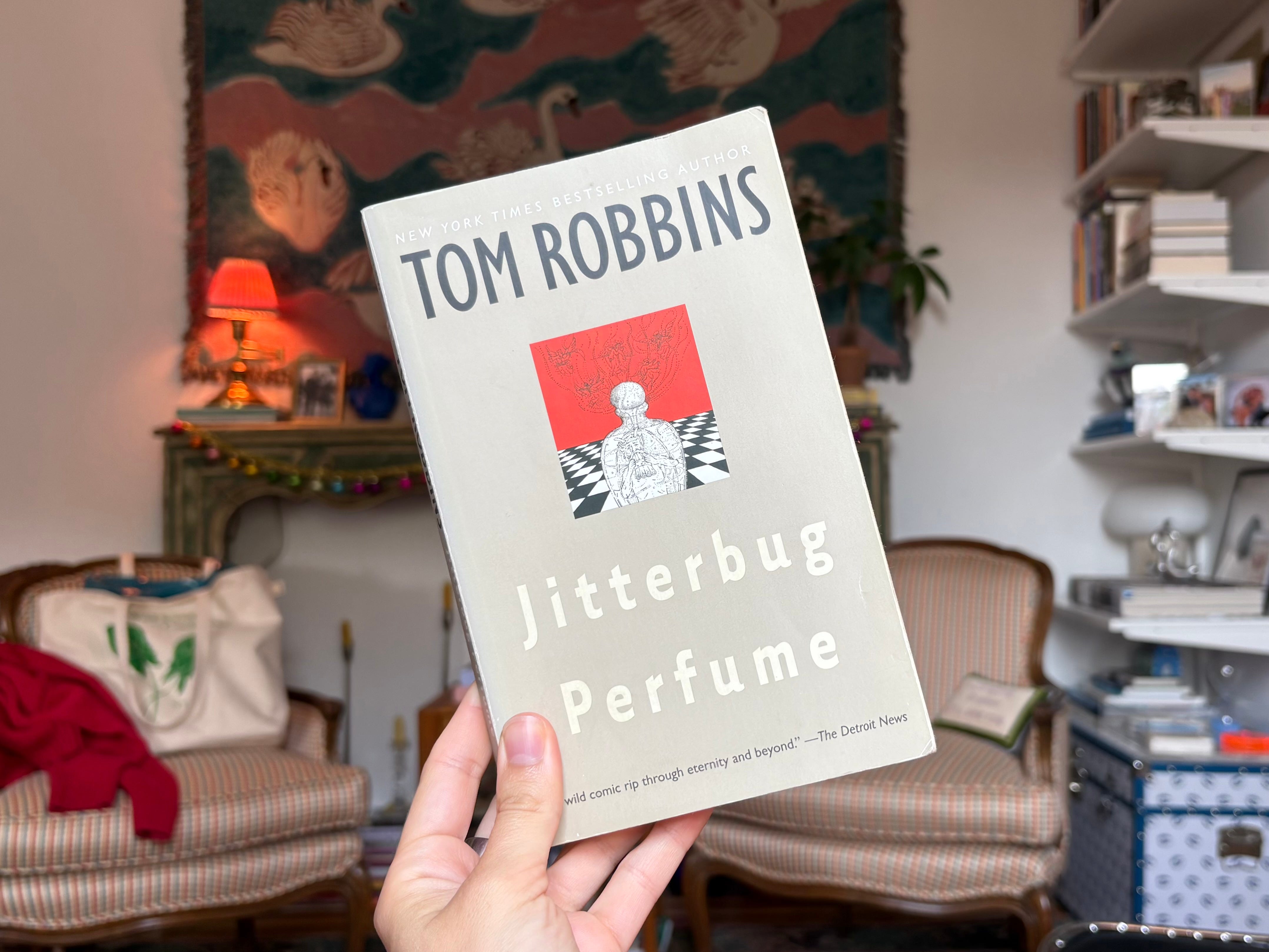
The novel opens with a tribute to/warning about the beet, “the most intense of vegetables,” before launching us into present day. We meet Priscilla in Seattle. She is a genius waitress (a type that Robbins defines in Wild Ducks!). Next, we meet Madame Devalier and her assistant V’lu processing Jamaican jasmine in New Orleans. Finally, the LeFever cousins come into view in Paris—Claude in his suit and Marcel in his…whale mask. What do these characters all have in common? They are perfumieres.
From there we head back to Eurasia in the 8th century where King Alobar has discovered a grey hair on his head. This spells disaster as in his kingdom, kings are executed and replaced at the first sign of aging (whether it be a grey hair or a wrinkle). He’s quite intent on staying alive, which kicks off a journey for the ages, ha ha. After running into the god, Pan, he heads east in search of the Bandaloop—a mysterious tribe that has discovered the secrets of immortality. Along the way, he picks up Kudra, a young Indian woman who is escaping suttee, the practice in which a widow is burned with the body of her deceased husband. Alobar and Kudra fall in love and spend the rest of their very long lives together.
The novel repeats this pattern, with shorter sections for Priscilla, Madame Devalier and the LeFevers followed by a longer chunk on Alobar and Kudra’s adventures, until everyone catches up with each other. If it all sounds insane, it really, really is. It’s a miracle that Robbins is able to land the plane in the end, tying together these disparate strands into something coherent and satisfying, but he is.
With immortality as a central concern, I found that the novel had much to contribute to our present cultural discourse re: reversing aging and extending life. It was less than a year ago that here, on this very page, in response to some chilling New Yorker long read on the crazy tech bros trying to live forever, I proclaimed, and I quote, “get old and DIE. It’s the whole point.” And I pretty much still feel that way, but I’ll tell you what, Robbins gave me A LOT to think about. For him life is abundance, joy, passion, fun, and why should that end?
About halfway through the novel, Alobar and Kudra encounter Lalo, a nymph and follower of Pan who commends their quest for immortality but warns them that:
Someday, however a thousand years from today, there wilt be men who seek to defeat death by intelligence alone. They wilt combat age and death with potions and the like, medical weapons that their minds have invented, and age and death will shrink back from them and their medicines. Alas, because they fight with reason only, making no advance in the area of soul and heart, true immortality wilst be denied them. However, they must not be allowed to attain even the false immortality that their mental facility doth gain for them, for huge evil will be conducted if they shouldst.
So then I knew Tom and I were on the same page.
His style and his voice are perfectly suited to his message—that one must be unapologetically oneself, convention be damned. His commitment to not taking himself too seriously is deadly serious. His style and his voice HAVE style and voice. His humor is irresistible, his puns mostly tolerable, his flaws forgivable. Most of all, he is having fun, which means you will have fun too. I can understand how his use of metaphor (LIBERAL) may not be for everyone, but what can’t be denied is that he loves language. Loves to play with it, and has gotten quite adept at doing so. 10/10 I loved it and am now devastatingly out of Robbins for the time being.
Luckily at the beginning of the month in an act of charity, my sweet sister bought me a copy of On The Calculation of Volume IV by Solvej Balle. Technically this is in violation of the spirit of my project to read the books I already own, but let he who is without sin cast the first stone, etc. I never said I was perfect (though I can see how you may have gotten that impression; my lover says I’m close to it!). I was deep in Robbins land when she gave it to me, but it was a comfort to know that it would be waiting for me when I was ready.
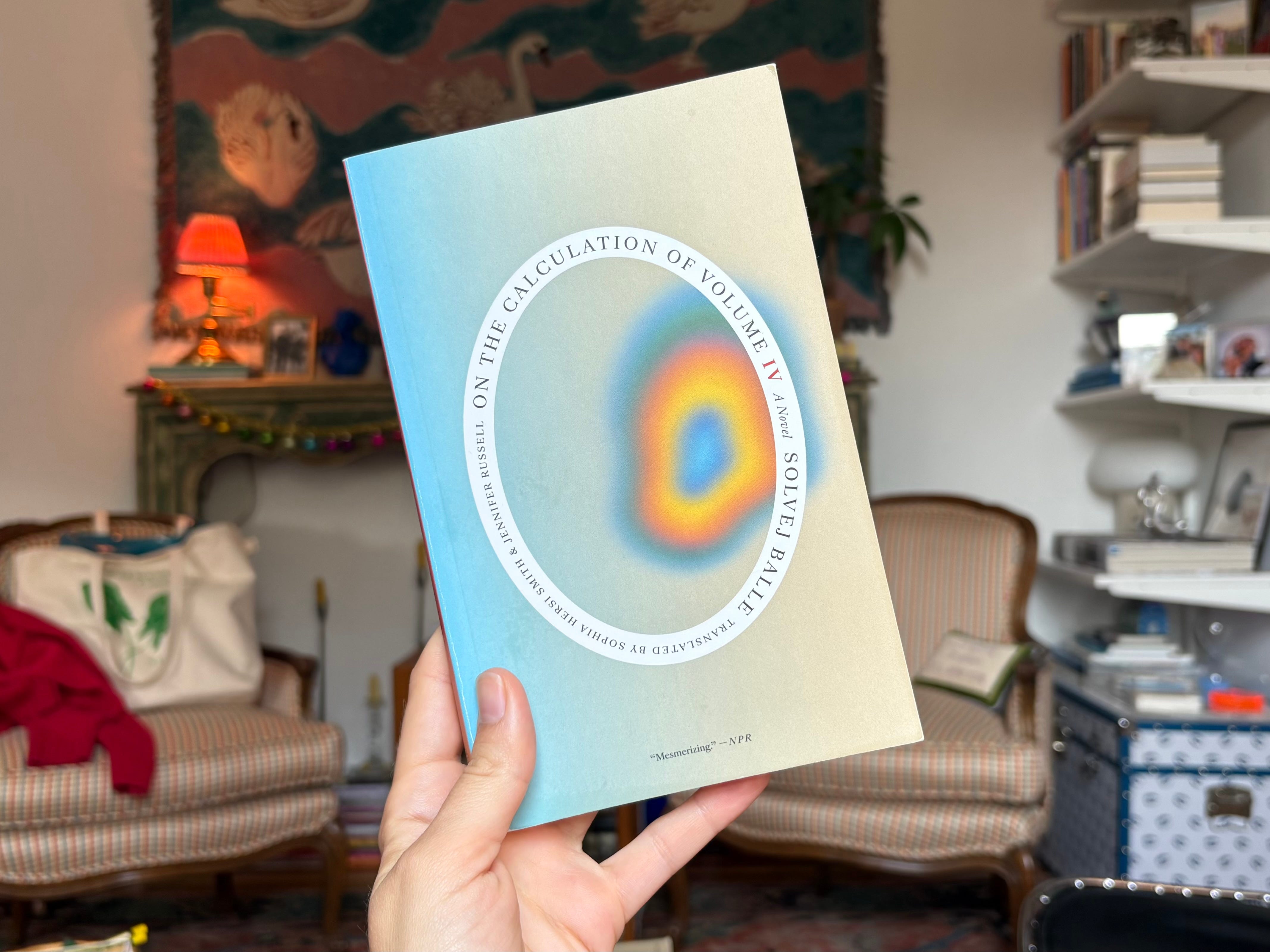
It’s hard to really say too much about this one, since it’s the fourth in a series. To even allude to the plot would be to spoil the progression of the first three books, which I’m not willing to do. For any who aren’t familiar, Balle’s series (which will ultimately consist of 7 books) focuses on Tara Selter, a woman who wakes up on 18th of November to a day she has already lived before. Then she keeps waking up to that day for another 3637 days (and counting!). I implore everyone to read these books. What Balle achieves is nothing short of a miracle. She makes the mundane inconceivably interesting; her pacing is second to none. I’ve said it before and I’ll say it again, every time I think I’m about to be over it (the premise, the repetition, the lack of action), she pulls me right back in. Book V is out in English in November (on November 17th, which is intriguing!).
Next up was Bonsai by Alejandro Zambra, which longtime readers may recall from my original month of short books. Regan kindly asked me to contribute to a newsletter on books that can be read in a single afternoon and Bonsai popped into my mind. I remembered loving it the first time I read it, and so, to write a fresh review for Regan, I sat down one afternoon and read it again.
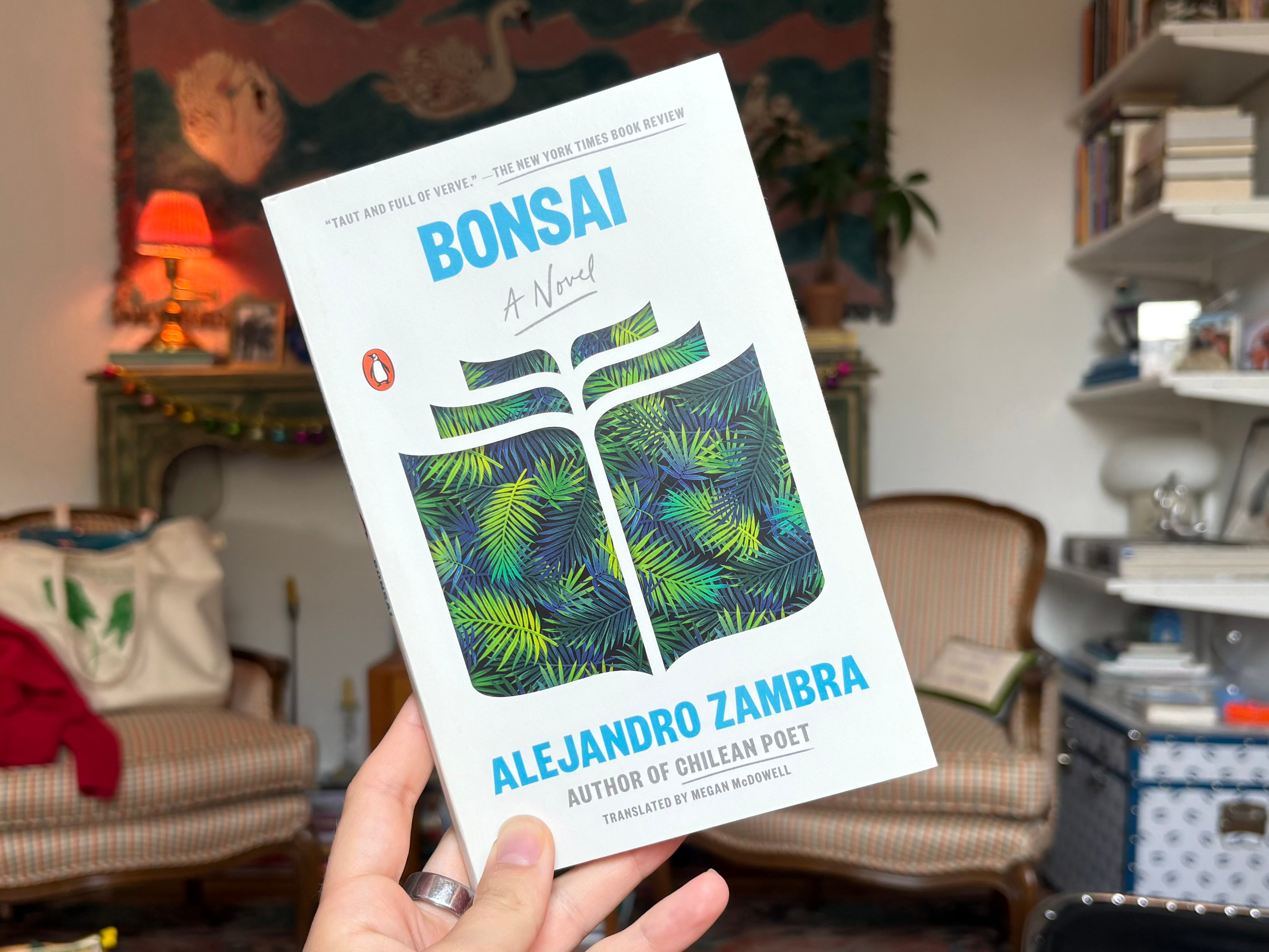
My review is linked below, along with nine other fantastic recommendations, which I will be procuring and devouring post haste, just as soon as I’m legally allowed to buy books again.

As you may have deduced by now, I tend to swing when it comes to my reading choices. Something old calls for something new next. Something feminine begs to be followed by something more masculine. Something short by something long. My friend Francis was over for dinner the other night and in admiring my bookshelf, pointed out The Lincoln Highway by Amour Towles. I own it in hardcover and it came out in 2021 so you can do the math on that. I thought now would be as good a time as any.
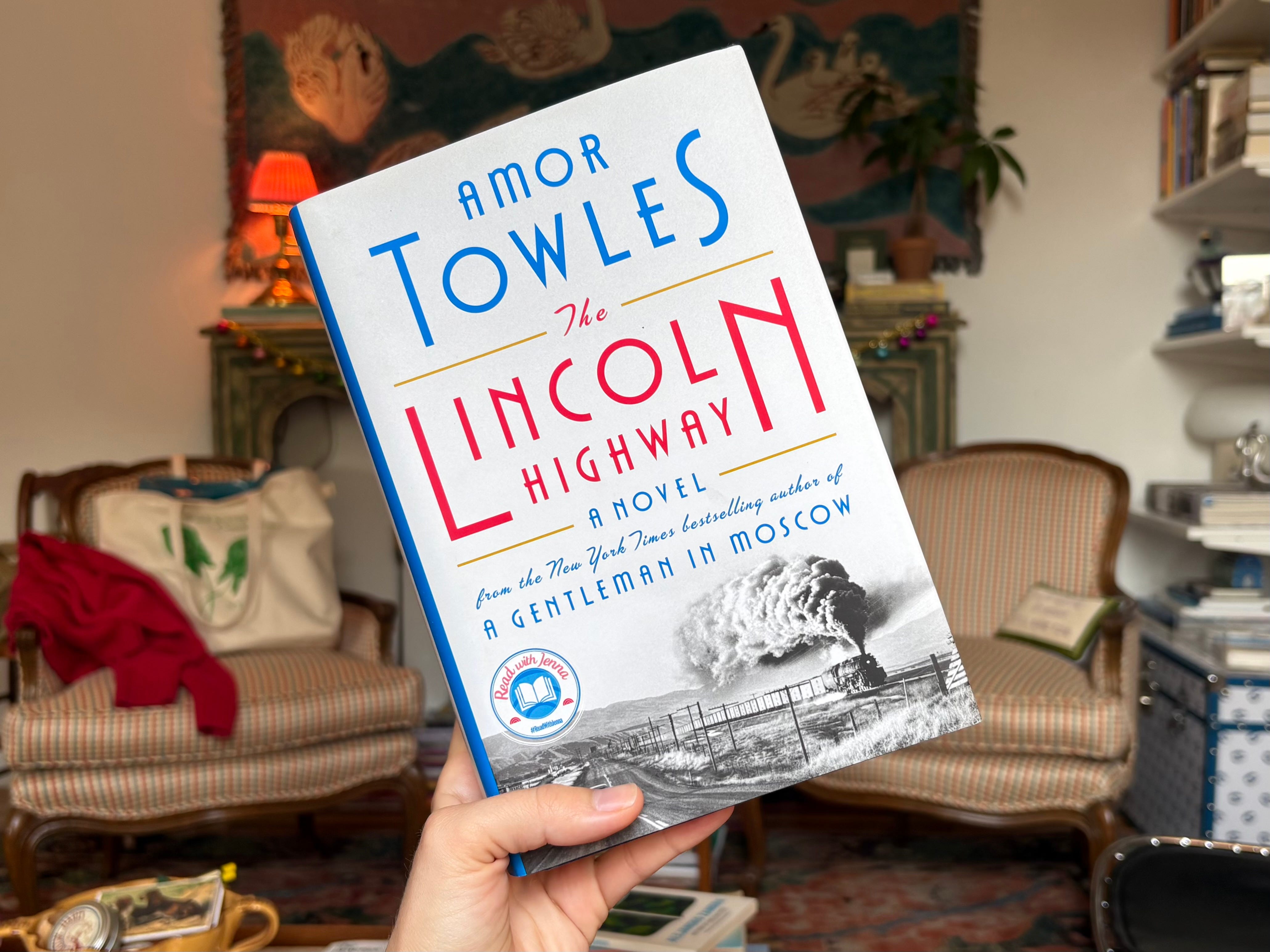
The novel is a very zoomed in coming of age story, set over the course of ten days in June of 1954. Emmett Watson arrives home after a stint serving time at juvenile detention camp, Salina, for a fight gone wrong. His father passed away while he was away, and he’s been let out of his sentence early so that he can care for his eight year old brother. Due to a long list of outstanding loans, the Nebraska farm where the boys grew up is in foreclosure. At just eighteen, Emmett has a plan. With nothing tying the boys down, they’ll travel to Texas where Emmett can use his experience in carpentry to buy up old houses, fix them up, then rent or sell them to turn a profit.
Billy—that’s the eight year old brother—has other ideas. When Emmett was away, Billy found a stash of postcards from their mother describing the journey she embarked on, west to San Francisco (yes, along the Lincoln Highway), after she unceremoniously abandoned her family ~8 years prior. He thinks they should go to California to find her, and believes that since she always loved the 4th of July, they’ll be able to find her at the fireworks show in Lincoln Park. Emmett decides that he can flip houses just as well in California.
Best laid plans, as they say! When the warden from Salina drove Emmett home, neither of them realized that Duchess and Wooly—two well-meaning but troubled agents of chaos—had hitched a ride in the trunk. When the warden leaves and Duchess and Wooly reveal themselves, things begin to veer off track. They want to go to Wooly’s family home in the Adirondack’s, where $150,000, is sitting in his grandfather’s safe, and they’d be more than happy to offer a three way split for Emmett’s trouble in getting them there. He’s resistant, but when they effectively steal his car, it’s off to New York for the whole crew.
The story was fun, and I appreciated some of what Towles was doing with his literary references. Much like in Homer’s Odyssey, he spins a tale of similarly constant setbacks and frustrations. To make sure you get it, he introduces a character named Ulysses. His invocation of Shakespeare’s tragedies is a bit more subtle, and ties in with the ending quite skillfully. However, for the first 532 pages (of 576), I felt like I was reading a young adult novel. Sorry!! I think part of that effect came from the alternating points of view (not a favorite device of mine), and think Towles would have benefited a lot from using a 3rd person omniscient narrator—like maybe Billy reminiscing as an old man?? This option is basically written into the book already, but Towles decides not to lean in.
Aside from that, the characters are constantly wiping tears from their cheeks, which started to drive me crazy. I cry legitimately all the time, and even I felt it was a bit overdone. It was folksy, saccharine, cliched, and more than anything, it felt like Towles was trying to write like Steinbeck and failing. Not to be that person, but the solitary female character was also so underdeveloped and confusing. Everyone and their mother seems to have given it a rave review, so I might be the crazy one. I just remember Rules of Civility being more grown up and feeling less like it was trying to hit me over the head with its own wisdom. Phew! Francis, if you’re reading this, let’s talk.
I was traveling when I was nearing the end of The Lincoln Highway, so I naturally had a backup book on hand. I picked it because it wasn’t too thick (with Towles hogging most of the space in my carryon) and because I knew it would be good (Woolf). I didn’t end up needing it on my trip, but decided to read it anyway when I got back. That book was Flush, by Virginia Woolf, a playful, quasi-fictional biography of Elizabeth Barrett Browning’s cocker spaniel by the same name.
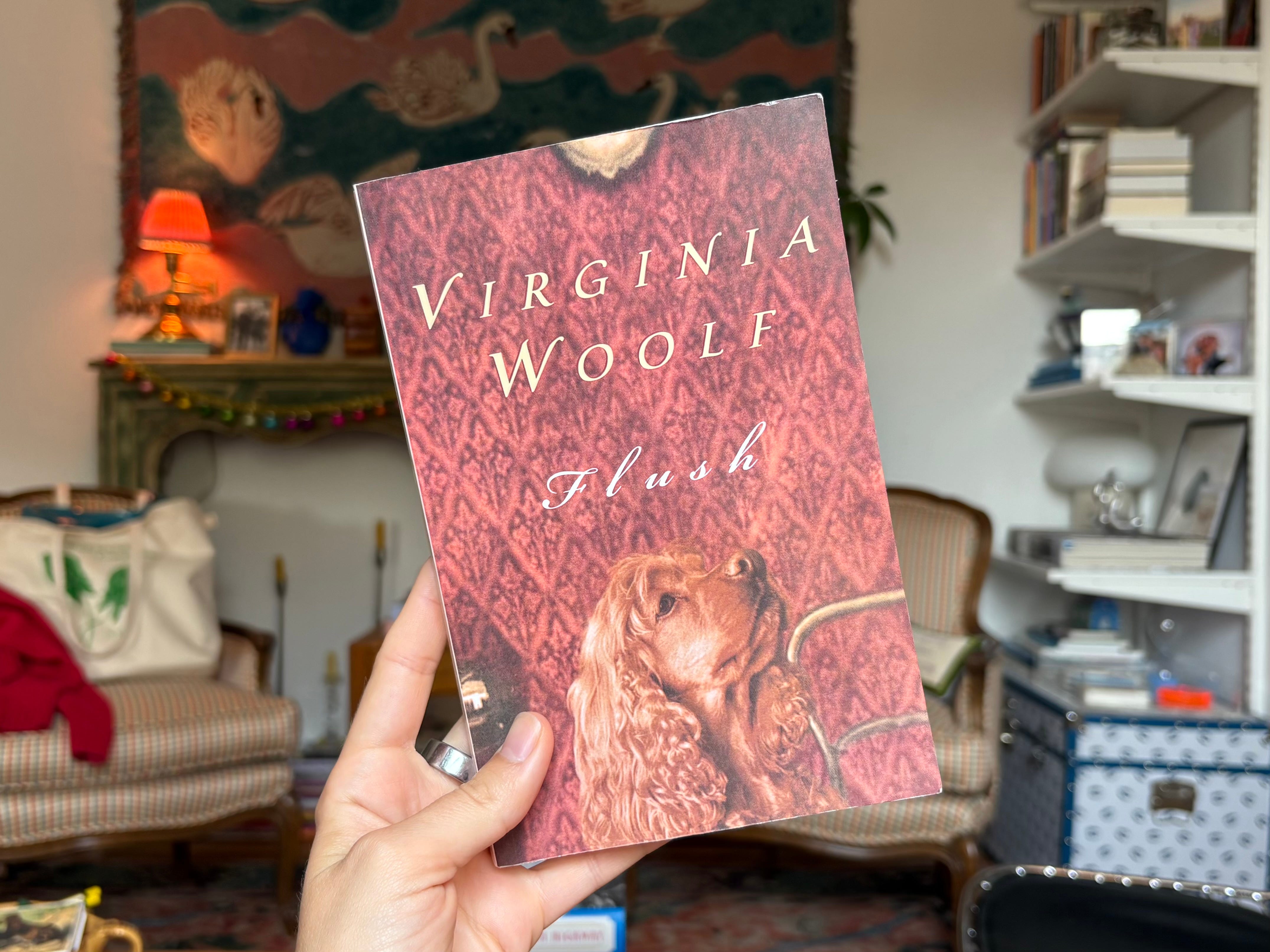
It was written after Woolf completed The Waves, which exhausted her (UNDERSTANDABLY if you’ve read it). She wanted to do something a bit lighter, and decided that EBB’s loyal companion, oft mentioned in her letters and writings, deserved a biography of his own. While she makes good use of Barrett Browning’s references, there was much that had to be invented. As such, Woolf chooses to put herself inside Flush’s mind, allowing greater artistic liberty while still building upon a frame of true events.
Woolf also uses Flush as a vehicle through which to examine the confining and repressive quality of life in Victorian England, particularly for women. On Wimpole Street, both Flush and EBB spend all their time in her darkened room. Barrett Browning’s poor health kept her indoors, but even when she was feeling well, the force of her father’s presence oppressed her. Even when she was able to go out, she was confined to her bath chair or carriage and Flush to his chain—all nice dogs in London must be led on chains.
When Elizabeth and Robert run off to Italy, everything changes. Their romance is surely one of the greatest.1 It allowed Barrett Browning to come into her own, and their removal to Italy completed her transformation. She became a much freer woman (and Flush a much freer dog). To witness it all through the eyes of her little Flush was delightful. Woolf displays her characteristic skill when playing with Flush’s interiority—his intuitive understanding of certain things and his inability to penetrate others.
I wrote about her Sonnets from the Portuguese here, and A.S. Byatt’s Possession is partially inspired by the Brownings as well.
I have a few run Robbins on my shed, maybe this is a sign from the universe to finally read them.
Wonderful reviews and inspiring ones, as well. I need to get to reading the books I already have before reading any of your suggestions, but I will probably do a little reading of my current stash and venture into some of your recommendations as well.